Why Your Sales Process Breaks the Moment You Get on Zoom
- Jim Fisher
- Practice Building
Key Takeaways (Tattoo These On Your Brain)
Key Takeaways (Tattoo These On Your Brain)
- You close $500K cases across a kitchen table but can’t close $50K on Zoom. Something invisible changed. You lost seven trust signals you never knew you had, and nobody told you that was the problem.
- Tokens of trust are the deliberate cues that build credibility during the sales process. Your office, your handshake, your appearance, your pre-built reputation. Every single one disappears the moment you go virtual.
- You don’t have a closing problem. You have a setup problem. In person, the environment does half the work for you. On Zoom, none of that exists by default. You have to build a new room.
- There are six new virtual trust tokens that replace what you lost. Systematic scripting, problem-first focus, stories, visual elements, professional virtual presence, and consistent follow-up communication.
1. The Invisible Trust Signals You Never Knew You Had
1. The Invisible Trust Signals You Never Knew You Had
A friend of mine named Pete does over $200 million a year in annuity production out of one office. Not a huge team. Not paid ads. He runs a radio show in his local market. And he told me something that stuck with me.
It’s not uncommon for someone to listen to his show for two years before they ever pick up the phone to book an appointment. Two years. That’s two years of his voice, his ideas, his philosophy pouring into someone’s car on their way to work every morning. By the time that prospect finally drives to his office, they already trust him. Before they shake his hand, they trust him.
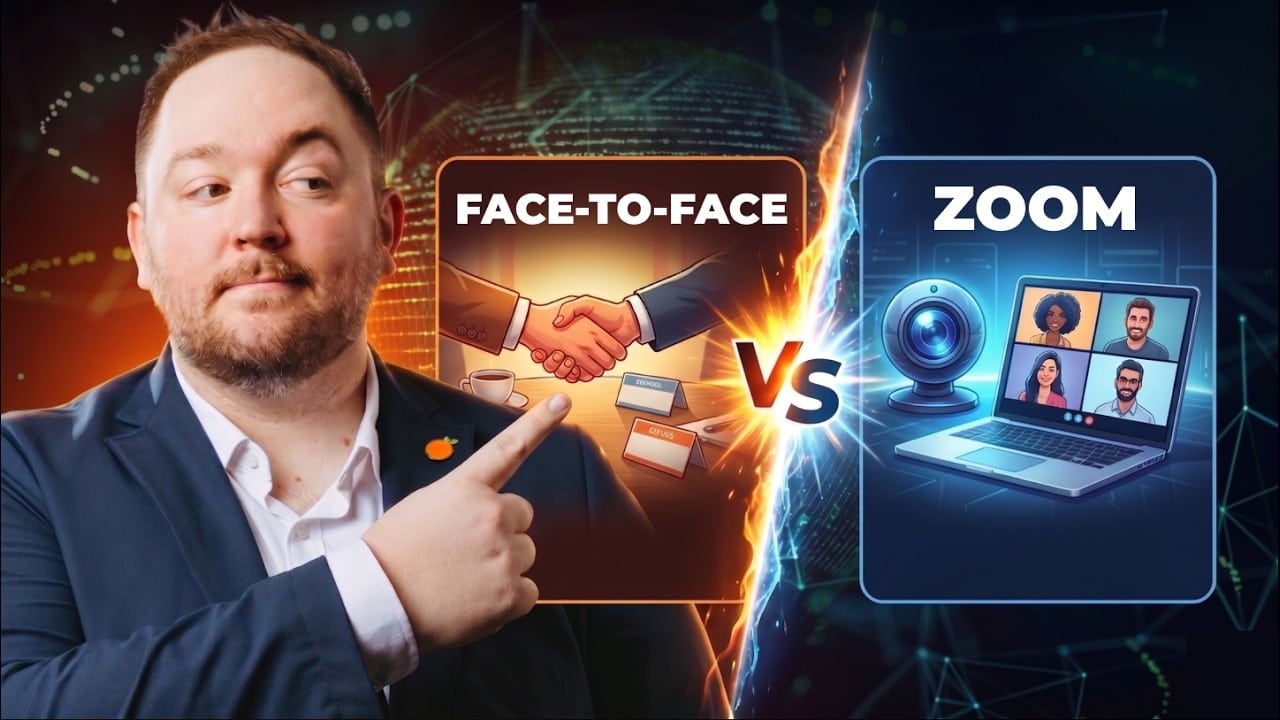
That’s the power of what I call tokens of trust: the deliberate cues, tangible and intangible, that you use to build credibility with a prospect during the sales process. Your physical environment. Your appearance. Your communication style. The quality of your presentation. All of these signals stack together and shape how the prospect sees your professionalism, your reliability, and the value you bring.
Most face-to-face advisors aren’t even aware they’re using them. Here are the seven trust tokens working for you every time a qualified prospect walks into your office:
- The commitment to travel. They left their house. They drove forty-five minutes. That effort is a powerful trust signal before you ever open your mouth.
- Your environment. The office itself. The diplomas on the wall. The branded materials on the conference table. It all says you’re real.
- Your appearance. You’re dressed like an advisor. You look the part. You ARE the part.
- Physical proximity. Sitting across from another human creates a dynamic a rectangle on a screen can’t replicate.
- The handshake and eye contact. Basic trust signals humans have used for thousands of years.
- Physical materials. A booklet they can hold. A printed plan. Something tactile.
- Pre-built rapport. Two years of radio. Ten years of referrals. A reputation in the community. All invisible. All doing the heavy lifting before you say a word.

You didn’t realize you depended on any of this. Because you never had to.
2. The Virtual Gap: Every Token, Gone
2. The Virtual Gap: Every Token, Gone
One of the best face-to-face closers I’ve ever known got on a Zoom with a prospect and froze. Thirty years in the business. Could close a million-dollar case sitting across the table from a client in his sleep. But on this Zoom, about five minutes in, something changed in his face.
Afterward he said, “I can feel they’re not with me.” And he was right. Because everything that made him magnetic in a room had disappeared.
Here’s what actually happens when you move that same face-to-face process onto a Zoom:
- The commitment to travel? Gone. They clicked a link from their couch.
- The office? Gone. They see a rectangle on a screen.
- Your appearance? Compressed into a face about the size of a playing card.
- Physical proximity? Not a thing.
- The handshake? Doesn’t exist.
- Physical materials? Nothing to hold.
- Two years of radio. Ten years of local reputation. Gone. When a cold Zoom call starts, you are starting from absolute zero.

Every single trust signal that carried you face-to-face just evaporated. And as one advisor put it perfectly: on Zoom, you’re just one click away from a forever goodbye.
Without those tokens, nothing is holding them in the conversation. There’s no social pressure. There’s no investment. There’s no room. They can be gone in an instant, and you’ll never know why.
3. It's Not a Closing Problem. It's a Setup Problem.
3. It's Not a Closing Problem. It's a Setup Problem.
Your IMO probably told you virtual doesn’t work in this business. Maybe you tried during COVID, hated every minute of it, and went back to in-person the second you could.
Here’s what actually happened. Virtual wasn’t the problem. The problem was trying to run a face-to-face process in an environment that didn’t have a single one of the trust signals that made it work. You weren’t bad on Zoom. You were flying a plane without a cockpit.
And here’s the subtle part. When you feel uncertain, the prospect feels it too. If you get on that call without your tokens, you can sense the trust gap. The prospect senses it back. Your uncertainty transfers. Their guard goes up. And the deal is essentially over before you even start.
Virtual selling isn’t harder. It’s just different.

Most advisors who struggle on Zoom don’t have a closing problem. They have a setup problem. In person, the environment does half the work for you. The room. The drive. The materials. The handshake. That environment is a collection of trust tokens doing the selling in the background.
On Zoom, none of that exists by default. If you don’t deliberately engineer new trust tokens into the process, the call just feels casual. Optional. Easy to bail on. You can’t copy the old room. You have to build a new one.
4. The Six New Tokens
4. The Six New Tokens
One of our advisors told me a client chose him over three other advisors. Not because of the product. Not because of the rate. Not even because of his track record.
The client said, “You sent me a detailed summary after every call. You were prepared for every meeting. You treated me like the most important person in the world.”
That advisor never met that client in person. Not once. And he built more trust in four virtual touches than most face-to-face advisors build in two hours at a kitchen table. That’s the kind of token system I’m talking about. Small. Deliberate. Visible. And compounding between every single call.
Here’s what a virtual-native token system actually looks like:
- Systematic scripting. What you say and how you say it has to be more deliberate. In person you can be conversational and still close. Virtually, the words, the tone, the flow all matter more. You need structure.
- Problem-first focus. Without physical trust signals, you build trust by demonstrating expertise. Diagnosing the prospect’s situation creates more trust than pitching a product ever will.
- Stories and narrative. You’re competing with a screen. Stories create emotional engagement that facts can’t. Narrative is a trust token that replaces physical proximity.
- Visual elements. Slides. A forecaster tool. A presentation that shows the math. 65% of people are visual learners, and the brain processes images 60,000 times faster than text. In person you can talk through it. Virtually, you have to show it.
- Professional virtual presence. Camera at eye level. Good lighting. A clean background that looks like a real workspace. This is the new version of “dressed like an advisor in a professional office.”
- Consistent follow-up communication. In person, the drive to your office was the commitment signal. Virtually, your follow-up emails, your meeting summaries, your prep materials ARE the commitment signal. They build trust between calls in a way a handshake never could.


The research backs up three drivers that move prospects to make a decision in a virtual setting: Narrative. Visuals. Data. Your stories, your slides, and the math. When all three are present in the call, decisions happen. When any one of them is missing, the prospect stalls.
5. What Happens When the System Is in Place
5. What Happens When the System Is in Place
When you put the whole system in, something shifts. You stop chasing. You stop convincing. Now you’re guiding. Not convincing. The trust is built before the prospect ever sits down on the Zoom. The tokens are doing the work between every call. And the sales process feels less like pushing and more like walking someone through a map they asked to see.
The forecaster is the virtual trust token that replaces the kitchen table better than anything else. It gives the prospect something visual and personal to react to. It shows them their own financial picture, the gap they’re sitting in, and how to close it. In a single meeting, it can flip prospects from “wait and see” to “we need to start today.”
Your skills didn’t become obsolete. They just lost their carrier. A kitchen table isn’t just furniture. It’s a delivery vehicle. For thirty years, you pushed your expertise, your empathy, your closing instincts through that vehicle. Then the vehicle changed. That’s not starting from zero. That’s translation. And translation is a skill you can learn in weeks, not decades.
The Bottom Line
The Bottom Line
You close $500K cases across a kitchen table and can’t close $50K on Zoom. The problem isn’t your skill. The problem is that every invisible trust signal that made your face-to-face process work just disappeared, and nobody told you it happened.
Seven tokens carried you in person. Every single one vanishes on Zoom. But there are six new ones that replace them. Systematic scripting. Problem-first focus. Stories. Visuals. Professional presence. Consistent follow-up. Build the new room, and your close rate doesn’t go down. It goes up. Because prospects come in more problem-aware and focused on implementing a solution with you than you’ve ever seen from a kitchen table.
Keep Watching
Keep Watching


Jim Fisher
Jim is an award-winning marketer and licensed producer. He has helped over 1000 agents and advisors scale their life and annuity production to become top 1% producers.
More from the blog